Every keyword in Google Ads has a match type, and it decides how closely a person's search must relate to your keyword before your ad can enter the auction. Choose well and you reach customers ready to buy. Choose badly and budget leaks into searches that were never going to convert.
- Match types set how closely a search must match your keyword: broad is the widest, phrase sits in the middle and exact is the narrowest.
- Broader match types cover everything narrower ones do, so you rarely need the same keyword in all three.
- Broad match works best with Smart Bidding and accurate conversion tracking.
- Negative keywords and regular search term reviews keep any match type profitable.
What is a keyword match type?
Keywords are the words or phrases you choose to match your ads with the terms people search for. The match type tells Google how closely a search needs to relate to that keyword for your ad to be eligible to show.
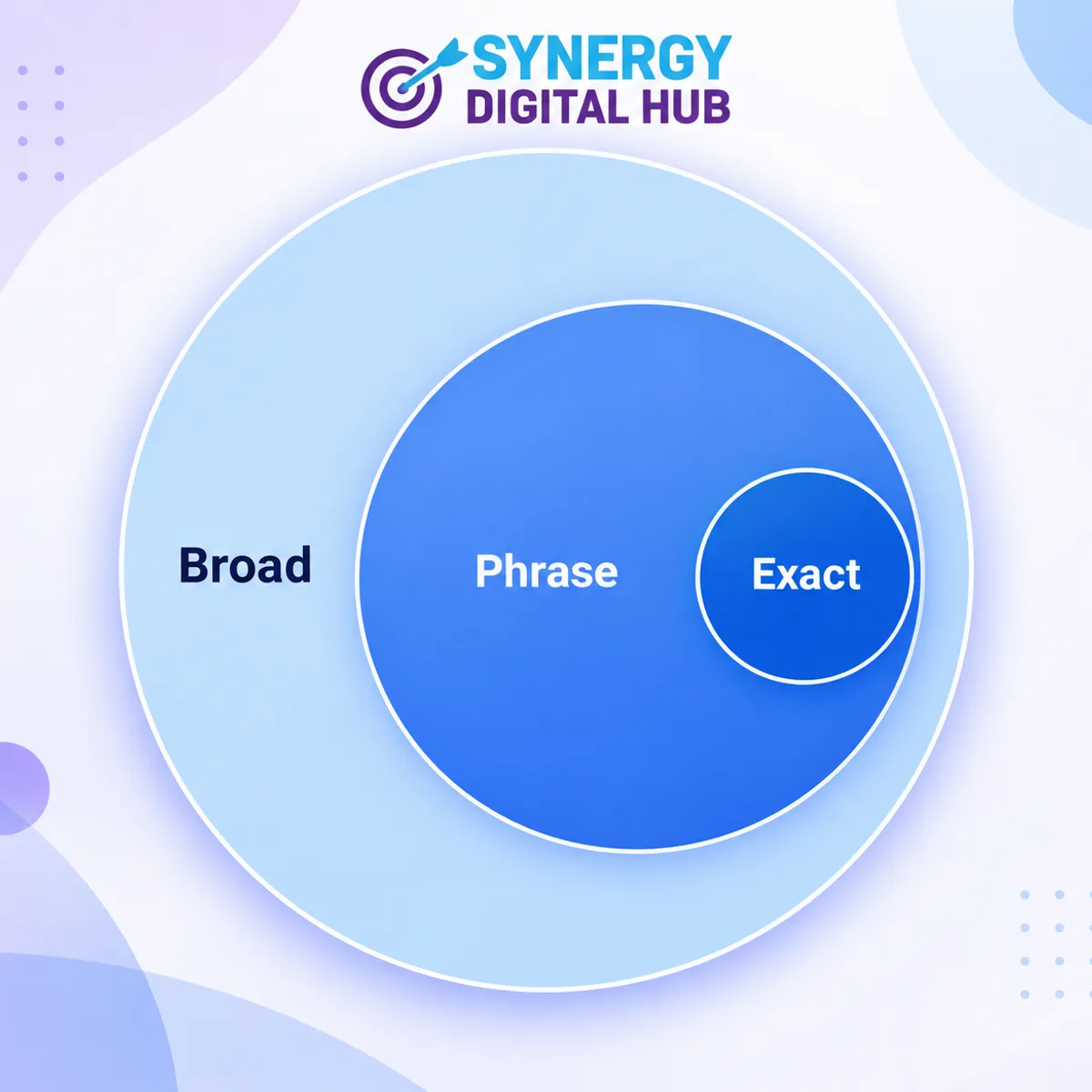
Match types sit on a scale from wide reach to tight control. The broader the match type, the more searches it can capture, but the more variation you accept in what triggers your ads.
Broad match
Broad match is the default. You type the keyword with no symbols, and your ads can show on searches related to it, even when those searches do not contain the keyword's direct meaning.
To find relevant searches, Google can consider signals such as a person's recent searches, the content of your landing pages and assets, and the other keywords in the ad group. That helps you reach more visitors and reduces how long your keyword list needs to be.
Google recommends pairing broad match with Smart Bidding, because every query is different and bids should reflect what is known at auction time. Without strong conversion tracking, broad match can spend quickly on searches that do not lead to enquiries.
- Syntax: running shoes (no symbols)
- Reach: widest
- Best for: accounts with solid conversion data and Smart Bidding
Phrase match
Phrase match uses quotation marks, for example "tennis shoes". Your ad can show on searches that include the meaning of your keyword, including more specific versions of it. It reaches more searches than exact match and fewer than broad match.
For most local service businesses, phrase match is a practical middle ground. It keeps the searches tied to the product or service you sell while still catching useful variations.
- Syntax: "tennis shoes" (quotation marks)
- Reach: middle
- Best for: balancing volume and relevance
Exact match
Exact match uses square brackets, for example [red shoe]. Your ad can show on searches with the same meaning or intent as the keyword. It reaches the fewest searches, but it gives you the most control over who sees your ad.
Use exact match for your highest-intent, best-converting terms, where you want to be certain of the message and landing page a searcher sees.
- Syntax: [red shoe] (square brackets)
- Reach: narrowest
- Best for: proven, high-intent keywords and tight budgets
How match types work together
Broader match types capture everything narrower ones do, so you do not need to repeat the same keyword as broad, phrase and exact. Adding near-duplicates, such as "red car" and "car red" as broad match, is not recommended either. Google treats them as duplicates and uses only the one with the higher Ad Rank.
If you run Performance Max alongside Search, a search that is identical to an eligible Search keyword of any match type is prioritised to the Search campaign. Otherwise the campaign or ad with the highest Ad Rank wins.
Negative keywords still matter
Negative keywords stop your ads showing on searches that contain a term you do not want. A hat seller that does not stock baseball hats could exclude "baseball hats", for example. Negative keyword match types behave differently from positive ones, so check how each works before adding long lists.
Reviewing the search terms report regularly shows which real searches triggered your ads, which ones converted and which should become new keywords or negatives.
Which match type should you start with?
There is no single right answer. A common approach for lead generation accounts is to start with phrase and exact match for control, confirm that conversion tracking is accurate, then test broad match with Smart Bidding and a strong negative list. Let search term data, cost per lead and revenue decide how far to widen.
If you are building or cleaning up a keyword list, my free Keyword Match Type Tool converts a pasted list into broad, phrase and exact formats and lets you copy or download the result.
Convert your keyword list in seconds
Paste your keywords into my free tool and get broad, phrase and exact match versions ready to upload to Google Ads.
Use the Keyword Match Type Tool →
Synergy Digital Hub
Two in-house marketing partners based in Melbourne, with 25+ years of combined experience and 1,000+ businesses served across Australia. We publish practical, plain-English guidance on SEO, paid ads, social media and websites. Meet us